Introduction to Focuse Lenses
Focuse Lenses play a major role in the performance of fiber laser cutting machines. These optical components directly control how laser energy is concentrated onto the material surface. Even a small change in lens quality or specification can affect cutting speed, edge finish, kerf width, and repeatability.
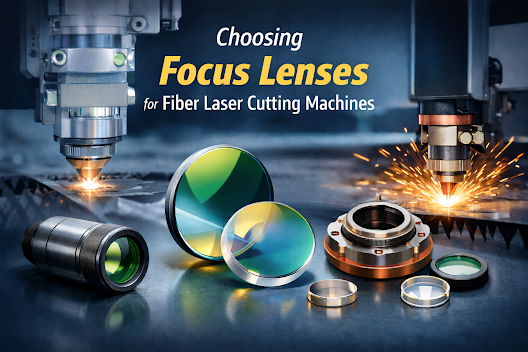
For manufacturers aiming to improve productivity and reduce scrap, selecting the right focuse lenses is a practical decision rather than a technical formality. This blog explains how to choose the correct lenses, what parameters matter most, and how price, coating, and compatibility influence long term machine results.
What Is a Collmating Lens in Fiber Laser Systems
A Collmating Lens is the first optical element the laser beam passes through after leaving the fiber output. Its job is to convert a diverging beam into a parallel beam before it enters the focuse lens.
Key points about Collmating Lens:
- Shapes the raw laser beam into a uniform, parallel path
- Helps maintain stable beam diameter across different cutting conditions
- Reduces stress on the focuse lens by distributing energy evenly
- Supports consistent cutting depth on thin and thick materials
Without a properly matched Collmating Lens, even the best focuse lens cannot deliver consistent results.
Role of Focuse Lens in Cutting Accuracy
The focuse lens is responsible for concentrating the parallel laser beam into a fine focal spot on the workpiece. This focused energy is what melts or vaporizes metal during cutting.
Functions of focuse lens:
- Determines spot size and power density
- Controls kerf width and edge smoothness
- Impacts piercing time and cutting speed
- Affects heat affected zone size
A poor quality focuse lens can lead to wider cuts, burr formation, incomplete penetration, and uneven edges.
Types of Focuse Lenses Used in Fiber Laser Cutting
Focuse lenses are available in different focal lengths and designs, each suitable for specific cutting tasks.
Common types include:
- Short focal length lenses for thin sheet and fine detailing
- Medium focal length lenses for mixed thickness jobs
- Long focal length lenses for thick plate cutting
Choosing the correct type depends on material thickness, cutting speed requirements, and machine power.
How Collmating Lens and Focuse Lenses Work Together
The Collmating Lens and focuse lenses function as a pair. Their alignment and compatibility determine overall beam quality.
Benefits of correct pairing:
- Stable focus position across long cutting cycles
- Reduced beam distortion at high power
- Improved consistency across the cutting table
- Longer service life for both lenses
Mismatch between these lenses often causes power loss and unstable cutting performance.
Material Quality in Focuse Lens Selection
Lens material quality is a deciding factor in cutting stability. Most focuse lenses are made from fused silica due to its thermal stability and low absorption.
Important material factors:
- High purity fused silica resists thermal cracking
- Low absorption reduces internal heating
- Uniform density prevents beam scattering
- Smooth surface finish improves transmission
Low grade materials may look identical but fail quickly under continuous fiber laser power.
Coating Technology in Focuse Lenses
Coatings applied to focuse lenses reduce reflection losses and protect the lens surface.
Quality coating features:
- Anti reflective layers for fiber laser wavelength
- High damage threshold for continuous operation
- Resistance to metal vapor and dust
- Easy cleaning without coating peel
Poor coatings lead to rapid power loss and frequent lens replacement.
Understanding Foucs Lenses Price Factors
Foucs lenses price varies widely based on several technical and manufacturing parameters.
Main factors influencing Foucs lenses price:
- Lens diameter and focal length
- Material purity and surface polishing
- Coating quality and number of layers
- Brand testing and quality control standards
Lower Foucs lenses price may reduce upfront cost but often increases downtime and replacement frequency.
Comparing Focuse Lenses Price vs Performance
Price should always be evaluated alongside performance and service life.
When comparing focuse lenses price, consider:
- Transmission efficiency over time
- Resistance to thermal deformation
- Cleaning cycle tolerance
- Stability during long production runs
In many cases, a moderately priced lens with stable output delivers better value than the cheapest option.
Choosing Focuse Lens Based on Material Type
Different materials require different focusing behavior.
Lens selection by material:
- Mild steel benefits from balanced focal length
- Stainless steel needs stable focus for clean edges
- Aluminum requires precise focus to avoid reflection issues
- Brass and copper demand high quality coatings
Matching the focuse lens to material type improves cut quality and reduces rework.
Power Rating Compatibility for Focuse Lenses
Fiber laser power continues to increase, making lens power rating critical.
Key considerations:
- Lens must handle peak and continuous power
- Coating should withstand high energy density
- Collmating Lens and focuse lens ratings must match
- Safety margin helps prevent sudden failure
Using under rated focuse lenses risks cracking and beam distortion.
Maintenance Impact on Foucs Lenses Price Value
Proper maintenance extends lens life and improves return on investment.
Maintenance best practices:
- Clean lenses with approved wipes only
- Avoid touching optical surfaces
- Inspect for coating damage regularly
- Replace protective windows on time
Good maintenance reduces effective Foucs lenses price over the lens lifespan.
Signs of Worn or Damaged Focuse Lens
Identifying lens issues early prevents production loss.
Warning signs include:
- Increased piercing time
- Rough or burnt cut edges
- Inconsistent kerf width
- Sudden power drop at the nozzle
Replacing the focuse lens at the right time protects other optical components.
Why Standardization Matters in Focuse Lenses
Using standardized focuse lenses simplifies inventory and maintenance.
Benefits of standard lenses:
- Easy replacement across machines
- Predictable cutting results
- Reduced operator error
- Lower spare stock complexity
Consistency in lens selection supports stable production planning.
Final Thoughts on Choosing Focuse Lenses
Selecting the right focuse lenses for fiber laser cutting machines directly affects cutting speed, edge quality, and machine reliability. Understanding the role of the Collmating Lens, the function of the focuse lens, and the real value behind Foucs lenses price helps manufacturers make informed decisions.
By focusing on material quality, coating performance, correct focal length, and proper maintenance, businesses can achieve reliable cutting performance and lower long term operating costs using the right focuse lenses.
For product support and technical guidance, contact at +91 8866608444 or mail at info@lasercart.co. You can also visit our website at www.Lasercart.co to know more.