Electronics manufacturing is evolving at an extraordinary pace. Manufacturers now demand permanent traceability, high-speed production, and reliable QR code marking on increasingly miniature components. Choosing the best laser marking machine for electronics components has therefore become a critical business decision. It directly affects product quality, production efficiency, and long-term competitiveness.
Traditional marking methods — such as inkjet printing and adhesive labels — are no longer reliable for modern electronics manufacturing environments. They smudge, fade, or peel under industrial conditions. Today’s manufacturers need precision traceability systems that deliver permanent, machine-readable marks on every component, every time.
Why Electronics Manufacturers Need Advanced Laser Marking Systems
Modern electronics production demands more than just a printed label. Every component — from printed circuit boards to miniature connectors — must carry a permanent, readable identification mark. This is essential for quality control, supply chain tracking, and regulatory compliance.
Industry 4.0 has fundamentally transformed how factories operate. Smart manufacturing systems now depend on digital traceability. Automated inspection lines scan QR codes and serial numbers at high speed. Any marking failure, consequently, creates costly production errors and rework.
Moreover, compact electronics present unique marking challenges. Components are small, heat-sensitive, and often manufactured at extremely high volumes. Traditional methods simply cannot keep pace. Here is why they fall short:
- Ink fading — Inkjet marks degrade with heat, moisture, or cleaning agents.
- Smudging and inconsistency — Ink-based systems produce variable print quality, especially at high speeds.
- Label peeling — Adhesive labels detach in harsh industrial environments.
- Consumable dependency — Ink and label supplies add recurring operational costs.
- Poor durability — Surface prints fail under thermal cycling, chemical exposure, or mechanical stress.
- Inconsistent print quality — Traditional methods cannot meet the precision requirements of modern smart manufacturing lines.
Laser marking solves all of these problems. It engraves directly into the material surface. The result is a permanent, high-contrast mark that survives the harshest conditions — with zero consumable cost.
As discussed in depth in our pillar guide, Why Electronics Manufacturers Use Laser Marking for Small Components, miniature component marking requires precision and repeatability that only laser technology can deliver consistently at scale.
How to Choose the Best Laser Marking Machine for Electronics Components
Selecting the right system involves evaluating several technical and operational factors. The best laser marking machine for electronics components is one that aligns with your material type, production volume, precision requirements, and automation goals.
Material compatibility is the first consideration. Metals, plastics, ceramics, and coated surfaces each respond differently to laser wavelengths. Always verify that the laser source matches your substrate before purchase.
Marking speed matters significantly in high-volume lines. Consider galvo scanner speed and laser pulse frequency when evaluating throughput capability. A system that cannot keep pace with your production rate creates bottlenecks.
Precision requirements vary by application. Fine-detail marks on micro-components demand high beam quality and a tight focus spot. Check the laser’s M² beam quality rating to confirm it meets your tolerances.
Heat sensitivity is a critical factor for PCB and plastic component marking. Certain substrates are damaged by thermal energy. UV lasers are the ideal choice here, as they operate through cold ablation with a minimal heat-affected zone.
Automation capability determines how well the system integrates into your production environment. Inline conveyor compatibility, PLC interface, and robot-arm integration are essential for smart factory deployment.
QR code readability must be verified before finalizing a system. Marks must be consistently machine-readable at production speed. Look for systems with validated QR code generation and built-in verification capability.
Production volume and maintenance requirements round out the selection criteria. High-volume OEM lines need industrial-grade systems with robust duty cycles. Fiber and UV lasers are largely maintenance-free, which significantly reduces total cost of ownership over time.
Types of Laser Marking Machines Used in Electronics Manufacturing
Different electronics applications require different laser sources. Understanding each type helps you identify the system that best fits your production environment.
Fiber Laser Marking Machines
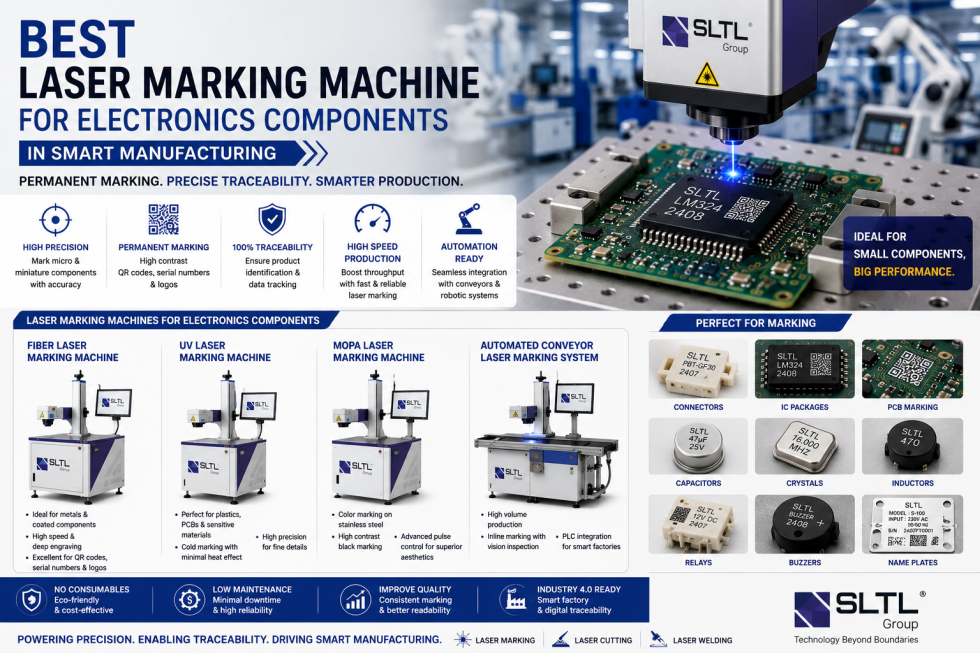
Fiber lasers are the most widely used laser source in industrial electronics marking. They operate at a 1064 nm wavelength and deliver exceptional performance on metals and coated materials. Fiber laser marking machines produce permanent, deep engravings that survive extreme heat, chemical exposure, and mechanical wear.
They are ideal for serial number engraving, QR code marking, and compact component identification on aluminum, steel, copper, and coated surfaces. Additionally, their high galvo scanner speeds make them the preferred choice for high-volume OEM production lines.
UV Laser Marking Systems
UV lasers operate at a 355 nm wavelength, enabling cold ablation marking. This means the laser removes material without generating significant heat — making UV laser marking systems the correct choice for heat-sensitive substrates such as FR4 PCBs, polyimide flex circuits, connectors, and IC packages.
The fine-detail capability of UV lasers makes them suitable for micro-component marking, where mark sizes are often smaller than 1 mm. They are furthermore widely used in medical electronics, consumer devices, and high-precision industrial applications where thermal damage is unacceptable.
CO2 Laser Marking Machines
CO2 lasers operate at a 10.6 µm wavelength, making them effective on non-metal materials. They are best suited for plastic enclosures, packaging materials, rubber components, and organic substrates. CO2 laser marking machines are commonly deployed in electronics packaging lines and for marking outer enclosure panels.
However, CO2 lasers are generally not suitable for direct metal marking without special coatings, and they are not recommended for fine-detail micro-component applications.
MOPA Laser Marking Machines
MOPA (Master Oscillator Power Amplifier) lasers offer advanced pulse control that standard fiber lasers cannot match. Users can independently adjust pulse width and frequency, enabling a wider range of marking effects on the same machine.
MOPA lasers can produce high-contrast black annealing marks on metals, color marking on stainless steel, and deep engraving — all without changing the laser source. They are particularly valuable for premium electronic nameplate applications, medical device marking, and high-contrast identification on dark metal surfaces.
Benefits of Using the Best Laser Marking Machine for Electronics Components
Laser marking delivers substantial advantages over conventional marking methods. These benefits translate directly into production efficiency, quality control improvements, and long-term cost savings.
Permanent marking capability is the most fundamental benefit. Laser marks are physically engraved into the material surface. They cannot be removed, smudged, or altered without damaging the component itself.
Contactless engraving means the laser never physically touches the component. This eliminates mechanical stress on delicate electronic parts and removes any risk of surface damage from contact pressure.
High-speed production support is achieved through galvo scanner technology. Modern industrial laser systems mark at speeds far exceeding inkjet or pad printing systems, supporting even the most demanding production line throughputs.
Zero consumables significantly reduce operating costs. There is no ink, no nozzles, no ribbons, and no labels to purchase or replace. The laser itself is the marking medium.
Precision QR code engraving enables smart traceability. Laser-marked QR codes are machine-readable, tamper-proof, and durable across the entire product lifecycle — from manufacturing through end-user service.
Automation integration transforms laser marking from a standalone process into a fully connected production step. SLTL systems interface with PLCs, vision systems, robots, and MES platforms for seamless Industry 4.0 deployment.
Overall, laser marking improves production efficiency, reduces rework, enables real-time automated inspection, and builds a reliable digital traceability record for every component produced.
Applications of Laser Marking in the Electronics Industry
Laser marking systems are widely deployed across all segments of the electronics manufacturing sector. The following applications represent the most common use cases:
PCB laser marking — UV lasers mark text, barcodes, QR codes, and component reference designators directly onto PCB surfaces without thermal damage to copper traces or substrate layers.
IC package engraving — Integrated circuit packages are marked with part numbers, date codes, and lot codes using fiber or UV lasers, providing full component-level traceability.
Connector marking — Plastic and metal connectors require fine-detail marking for identification. UV lasers handle plastic connectors without distortion; fiber lasers address metal connector bodies.
Electronic nameplate marking — Fiber and MOPA lasers engrave permanent nameplates on aluminum and stainless steel panels used in industrial electronics enclosures and control systems.
QR code engraving — All laser types support QR code marking. Selection depends on substrate material. QR codes enable automated digital traceability throughout the supply chain.
Barcode and serial number marking — Permanent barcode and serial number marking supports warranty tracking, anti-counterfeiting, and regulatory compliance across electronics product lines.
Filter cap traceability — Aluminum and polymer filter caps used in power electronics and consumer devices are marked with laser systems for production lot identification.
Electronics enclosure identification — ABS, steel, and aluminum enclosures receive permanent identification marks integrating production date, model code, and certifications.
Laser marking also works closely with laser cutting and electronics enclosure manufacturing processes. In modern production cells, laser cutting shapes enclosure panels while laser marking applies identification — all within the same automated line. This integration supports Industry 4.0 principles: digital manufacturing, automated inspection, real-time data capture, and reduced production errors. Smart factories now rely on laser marking as a foundational technology for end-to-end component traceability.
SLTL Laser Marking Solutions for Electronics Manufacturing
SLTL Group offers a comprehensive range of industrial laser marking systems purpose-built for electronics manufacturing. Each system is engineered for precision, automation compatibility, and long-term production reliability.
Fiber Laser Marking Systems
SLTL fiber laser systems deliver high-speed metal engraving and permanent industrial marking across a wide range of alloys and coated surfaces. They support QR code traceability, serial number engraving, and compact component marking. With minimal maintenance requirements and long service life, they offer an excellent total cost of ownership for high-volume electronics production.
UV Laser Marking Systems
SLTL UV laser systems are designed for heat-sensitive plastic marking, fine-detail PCB engraving, and connector identification. Cold ablation technology ensures zero thermal damage to sensitive substrates. These systems are suitable for medical electronics, consumer devices, and precision industrial applications.
MOPA Laser Marking Systems
SLTL MOPA systems provide advanced pulse control for high-contrast black marking on metals, color annealing on stainless steel, and premium nameplate engraving. Adjustable pulse width and frequency give operators flexibility across a wide range of materials and marking requirements without changing equipment.
Automated Conveyor Laser Marking Systems
SLTL automated conveyor systems integrate directly into existing production lines. They are compatible with PLC controllers, vision-based inspection systems, and MES platforms. These systems support high-volume production throughput, automated quality verification, and full Industry 4.0 and IIoT connectivity — making them the ideal choice for smart factory deployment.
All SLTL laser marking solutions support smart traceability, compact component marking, automated inspection, and digital manufacturing integration for modern electronics production environments.
Frequently Asked Questions
Which laser type is best for PCB marking? UV laser marking systems are the preferred choice for PCB marking. They use a 355 nm wavelength that ablates material with minimal heat transfer, preventing thermal damage to heat-sensitive substrates like FR4 and polyimide. UV lasers deliver extremely fine-detail marks, making them ideal for micro-component identification, connector marking, and IC package engraving.
Can laser marking machines handle all electronics materials? Different laser sources are optimized for different materials. Fiber lasers work best on metals and coated surfaces. UV lasers excel on plastics, glass, and heat-sensitive substrates. CO2 lasers are suitable for organic materials and enclosures. MOPA lasers offer versatility across metals with adjustable pulse control. Selecting the correct laser source for your substrate ensures optimal mark quality and durability.
How fast can a fiber laser mark QR codes on components? Industrial fiber laser marking systems can mark a standard QR code in under 1–2 seconds, depending on code size, material, and required depth. High-speed galvo scanner systems support production rates of hundreds of components per minute when integrated into automated conveyor lines.
Can laser marking systems be integrated into automated production lines? Yes. Modern industrial laser marking systems support full automation integration via PLC interfaces, Ethernet communication, and robot-arm compatibility. Inline conveyor laser marking stations synchronize with upstream and downstream production processes. SLTL automated systems additionally support vision-based quality inspection, enabling real-time verification of each marked component.
What are the maintenance requirements for industrial laser marking machines? Fiber and UV laser marking systems are largely maintenance-free. They use solid-state laser sources with no consumables — no ink, no nozzles, no filters to replace. Routine maintenance involves periodic cleaning of the optical and focus lens. Most industrial laser systems have operational lifespans of 80,000–100,000 hours, delivering an exceptionally low total cost of ownership.
Conclusion
Precision traceability is no longer optional in modern electronics manufacturing — it is a production requirement. Choosing the best laser marking machine for electronics components directly determines product quality, production throughput, and long-term competitiveness in a fast-moving market.
Fiber, UV, CO2, and MOPA laser systems each serve specific materials and applications. Understanding these differences allows electronics manufacturers, OEM suppliers, and production engineers to deploy the right technology for their specific needs.
Furthermore, automation integration and Industry 4.0 compatibility are now essential selection criteria. Smart laser marking systems connect seamlessly with production lines, inspection systems, and digital manufacturing platforms — enabling real-time traceability from component to finished product.
SLTL Group delivers industrial-grade laser marking, laser cutting, and laser welding solutions built for the demands of modern electronics manufacturing. Whether you need high-speed fiber laser marking, delicate UV PCB engraving, or a fully automated conveyor marking system, SLTL has the technology to match your production goals.
The future of electronics manufacturing is smart, fast, and permanently traceable. Make sure your marking technology keeps pace.