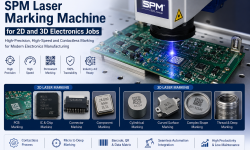
Electronics manufacturing is evolving rapidly. Traceability, quality control, and automation are no longer optional — they are essential. Black and white laser marking for electronics has become a critical technology for manufacturers who need permanent, high-contrast markings on small, complex components.
Today, every PCB, filter cap, connector, and industrial component must carry readable identification. Serial numbers, QR codes, and barcodes must remain legible throughout a product’s entire lifecycle. Traditional ink printing simply cannot meet these demands. Ink fades under heat. Labels peel under pressure. Smudging and inconsistent print quality cause traceability failures on the production floor.
Precision traceability in electronics manufacturing requires a better solution. Laser marking delivers permanent, clean, and machine-readable marks on even the smallest electronic components — without contact, consumables, or compromise.
In this guide, we explain how black and white laser marking works, why it matters for electronics manufacturers, and how modern laser systems support smart manufacturing goals.
Why Black and White Laser Marking for Electronics Is Important
Electronics components are getting smaller. Marking them accurately is getting harder. However, the traceability requirements are getting stricter. Black and white laser marking for electronics directly addresses this challenge.
Why Laser Marking Solves These Problems
Laser marking creates permanent identification marks by changing the surface of the material itself. There is no ink involved. There is no contact. The mark cannot smear, peel, or fade.
Moreover, black and white laser marking for electronics supports Industry 4.0 traceability systems. Each marked component carries a unique digital identity — readable by scanners, cameras, and automated inspection systems.
Benefits of Black and White Laser Marking for Electronics
The advantages of switching to laser marking are substantial. Electronics manufacturers worldwide are adopting this technology for good reasons.
1. Permanent, Durable Identification
Laser markings are part of the material surface. They survive extreme temperatures, chemical exposure, mechanical stress, and years of field use. Once marked, the identification cannot be removed accidentally.
2. High-Contrast Black and White Marks
Laser systems produce deep black engravings on light surfaces and bright white marks on dark surfaces. This high contrast is essential for QR code readability and barcode scanning in automated production lines.
3. Contactless, Non-Destructive Process
The laser beam never physically touches the component. Therefore, there is zero risk of mechanical damage, even on the most delicate PCBs and miniature connectors.
4. No Consumables Required
Unlike ink printing, laser marking requires no ink, ribbons, labels, or chemicals. Consequently, manufacturers reduce ongoing operational costs significantly.
5. High-Speed Production Compatibility
Modern laser marking systems operate at extremely high speeds. They integrate seamlessly with automated conveyor systems, supporting continuous production without slowing output rates.
6. Precision Engraving on Small Surfaces
Laser systems focus beams to spot sizes smaller than 0.1mm. This precision makes them ideal for marking filter caps, microchips, connectors, and other miniature electronic parts.
7. Automation and Smart Factory Integration
Laser marking machines integrate with PLC systems, vision inspection cameras, and ERP software. This integration enables real-time digital traceability across the entire production line.
Furthermore, as we detail in Electronics Enclosure Manufacturing and Laser Solutions, the same laser platforms that mark components also support enclosure cutting and welding — creating a unified production ecosystem.
How Black and White Laser Marking Works
Understanding the science behind black and white laser marking for electronics helps manufacturers choose the right system for their specific application.
The Laser Marking Process
A laser marking machine directs a focused beam of laser energy onto the material surface. Depending on the material and application, different marking processes occur:
Surface Color Change (Plastics and Coated Materials)
The laser breaks chemical bonds in plastic or coating materials. This changes the surface color — typically creating a dark black mark on light plastics or a bright white mark on dark substrates. No material is removed. The surface texture remains smooth.
Oxidation Marking (Metals)
When a laser heats a metal surface to its oxidation threshold, a thin oxide layer forms. This oxide layer appears black or dark brown. The process is called laser annealing or laser oxidation marking. It is commonly used on stainless steel, titanium, and aluminium.
Laser Engraving (Deep Marking)
For applications requiring tactile marks, the laser removes material to create a recessed engraving. This produces deep black marks on metals and is often used for serial numbers and logos on industrial components.
Contrast Generation
High contrast is critical for QR code scanning and barcode readability. Fiber laser systems achieve exceptional contrast by precisely controlling beam power, frequency, and scan speed. Black marks on silver metal and white marks on black anodized aluminium are both achievable with the same system — simply by adjusting laser parameters.
Compatible Materials
Black and white laser marking for electronics works across a wide range of materials used in electronics manufacturing:
- Stainless steel and aluminium (enclosures, connectors, heat sinks)
- FR4 PCB substrates and solder masks
- Engineering plastics (ABS, PA, POM, PEEK)
- Coated metals and anodized aluminium
- Electronic-grade polymers
- Industrial alloys and titanium
Applications of Black and White Laser Marking in the Electronics Industry
Laser marking serves diverse applications across the electronics manufacturing sector. Here are the most common use cases:
QR Code Marking
Two-dimensional QR codes carry maximum data in minimum space. Laser systems engrave high-density QR codes on PCBs, filter caps, and connectors — codes that remain scannable even after years of field use.
Serial Number and Batch Code Engraving
Every component needs a unique identity. Laser marking engraves permanent serial numbers, batch codes, and date codes — supporting full product lifecycle traceability.
PCB Laser Marking
PCBs carry identifiers on solder mask surfaces. UV laser systems create fine, precise marks without damaging sensitive circuitry. PCB laser marking supports automated assembly, inspection, and repair processes.
Filter Cap Marking
Capacitors and filter components require compact, readable identification. Laser marking produces clear black-on-silver or white-on-black marks on cylindrical and flat cap surfaces without harming the component.
Connector and Cable Marking
Electronic connectors need permanent polarity indicators, part numbers, and compliance symbols. Laser marking delivers all of these without adhesive labels that could interfere with connector mating.
Industrial Traceability Coding
Barcodes, Data Matrix codes, and alphanumeric identifiers on industrial control panels, switchgear, and relay components are all achievable with laser marking systems.
Logo and Compliance Marking
CE marks, UL logos, RoHS symbols, and brand logos are permanently engraved on products — meeting regulatory compliance requirements without additional labelling steps.
Smart Manufacturing Integration
Laser marking does not operate in isolation. In modern smart factories, laser marking machines connect to vision inspection systems, robotic pick-and-place arms, and MES (Manufacturing Execution Systems). This integration eliminates manual scanning steps and reduces production errors.
Additionally, laser cutting systems often work alongside laser marking stations. Electronics enclosure panels, for example, may be laser cut to precise dimensions and then laser marked with identification codes — all within the same automated production cell. Similarly, laser welding systems join housings and brackets, while laser marking systems apply the final identification. This unified approach is reshaping modern electronics manufacturing.
SLTL Laser Marking Solutions for Electronics Manufacturing
SLTL Group offers a comprehensive range of laser marking systems designed specifically for electronics manufacturing environments. Each system is engineered for precision, speed, and smart factory integration.
Fiber Laser Marking Systems
SLTL fiber laser marking systems are the workhorses of electronics production lines. They deliver:
- High-speed metal marking for connectors, heat sinks, and enclosures
- QR code and Data Matrix engraving on miniature components
- Permanent industrial traceability markings that survive harsh environments
- Compact component marking with beam spot sizes under 0.1mm
Fiber lasers operate at 1064nm wavelength — ideal for metals, coated metals, and dark engineering plastics. They offer excellent black and white contrast on most metallic electronics components.
UV Laser Marking Systems
UV laser systems (355nm wavelength) are engineered for heat-sensitive and precision applications:
- PCB and flexible substrate marking without thermal damage
- Plastic component marking with fine micro-engraving capability
- Glass and ceramic electronics marking
- Pharmaceutical-grade marking on medical electronics
laser energy is absorbed by most materials without generating significant heat, making it ideal for delicate PCB components and polymer housings.
CO2 Laser Marking Systems
CO2 laser systems (10,600nm wavelength) excel at non-metal marking applications:
- Cardboard and paper packaging labelling for electronics products
- Rubber and silicone component marking
- Wood and industrial labelling for electronics assembly documentation
- Non-conductive substrate marking
Automated Conveyor Laser Marking Systems
For high-volume electronics production, SLTL offers fully automated conveyor-integrated laser marking solutions:
- Inline production integration — components pass under the laser without stopping
- Smart factory compatibility — connects to MES, ERP, and SCADA systems
- High-volume production support — mark thousands of components per hour
- Automated quality inspection — integrated vision systems verify mark quality in real time
These systems eliminate manual loading and unloading steps entirely. Production engineers define marking parameters once, and the system runs autonomously — delivering consistent, high-quality marks across every production shift.
All SLTL laser marking solutions support electronics traceability standards, Industry 4.0 data requirements, and compact component marking — making them suitable for PCB manufacturers, OEM suppliers, filter cap manufacturers, and precision component producers.
Frequently Asked Questions
Q1: How fast can a laser marking machine mark electronics components?
Modern fiber laser marking systems can mark a QR code or serial number in 1–3 seconds per component. Automated conveyor systems can process thousands of components per hour, depending on mark size and complexity. High-speed galvo scanners ensure minimal cycle times even for complex Data Matrix codes.
Q2: Which materials are compatible with black and white laser marking for electronics?
Laser marking systems are compatible with stainless steel, aluminium, anodized metals, FR4 PCB substrates, ABS, PA, POM, PEEK plastics, coated metals, glass, and ceramic materials. Different laser types — fiber, UV, and CO2 — cover the full range of electronics manufacturing materials.
Q3: Can laser marking machines integrate with automated production lines?
Yes. SLTL laser marking systems support full automation integration via PLC, Ethernet, RS-232, and industry-standard communication protocols. They connect with conveyor systems, robotic arms, vision inspection cameras, MES software, and ERP platforms — making them ready for smart factory environments.
Q4: Do laser markings meet industrial traceability standards?
Laser markings comply with major traceability standards including ISO/IEC 15415 (2D barcode quality), GS1 Data Matrix standards, UDI (Unique Device Identification) for medical electronics, and automotive traceability requirements (AIAG, VDA). The permanent nature of laser marks ensures data integrity throughout the product lifecycle.
Q5: How much maintenance do laser marking machines require?
Laser marking machines require very little maintenance compared to traditional ink or pad printing systems. There are no consumables to replace. Fiber laser sources have operational lifetimes exceeding 100,000 hours. Routine maintenance typically involves lens cleaning and optical path inspection — taking less than 30 minutes per week.
Conclusion
The electronics manufacturing industry demands permanent, readable, and automated marking solutions. Black and white laser marking for electronics delivers exactly that — high-contrast marks that survive the full product lifecycle, integrate with smart factory systems, and eliminate the cost and reliability problems of traditional ink-based methods.
From PCBs to filter caps, from connectors to industrial control panels, laser marking has become the standard for traceability, quality control, and compliance. The shift toward Industry 4.0 manufacturing makes this technology even more essential. Automated laser marking stations, connected to digital production systems, are the foundation of modern smart manufacturing.
SLTL laser marking, cutting, and welding solutions give electronics manufacturers the tools to modernize their production — achieving higher precision, better traceability, and lower operational costs.
Upgrade your electronics production line today. Explore SLTL’s laser marking solutions, laser cutting machines, and laser welding systems — and take the first step toward smarter, more efficient manufacturing.