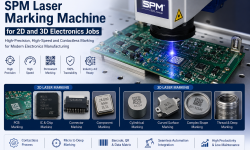
In today’s fast-moving industrial landscape, traceability is no longer optional — it is a production standard. Every component that leaves a manufacturing line must carry clear, permanent, and machine-readable identification. For small parts like filter caps, this requirement is especially demanding. Laser marking for filter cap manufacturing has emerged as the most reliable, precise, and automation-compatible solution for meeting these traceability requirements in modern electronics manufacturing environments.
Filter caps are compact, widely used components found across automotive electronics, industrial control systems, power supplies, and consumer devices. Marking them accurately — with batch numbers, serial codes, QR codes, or brand logos — is critical for quality control, product authentication, and regulatory compliance. Traditional methods like pad printing and inkjet coding fall short on small curved surfaces, fail in harsh operating environments, and add ongoing consumable costs that erode profitability.
Laser marking solves all of these challenges in a single step. It delivers permanent traceability markings without consumables, integrates seamlessly with automated production lines, and maintains consistent quality across millions of cycles. As precision traceability becomes a core requirement in smart manufacturing, laser marking is the technology that electronics and component manufacturers are turning to.
Why Laser Marking for Filter Cap Manufacturing Is Important
Filter caps are produced in high volumes, often as part of complex electronic assemblies. Each unit may need to carry unique identification — batch numbers, production dates, compliance codes, or QR traceability links — in a space no larger than a few square millimetres. Getting this right, consistently and at speed, is one of the most demanding challenges in component manufacturing.
Product authentication is another critical driver. Counterfeit components are a real threat in the electronics supply chain. Laser-marked identifiers that are permanently bonded to the component surface are virtually impossible to replicate or remove — providing a strong line of defence against counterfeiting and ensuring that only genuine parts reach the end customer.
Conventional marking methods simply cannot meet these requirements reliably. Inkjet and pad printing both depend on consumable inks that fade over time, smudge during handling, and become unreadable in humid or chemically aggressive environments. Maintenance requirements are high, and marking quality degrades as printing heads wear. Labelling adds material costs and the risk of labels detaching during assembly or field operation.
Laser marking for filter cap manufacturing eliminates all of these limitations. The laser permanently modifies the material surface through annealing, engraving, or ablation — producing marks that are chemically resistant, UV stable, and mechanically durable for the life of the component. For high-speed production environments running thousands of filter caps per shift, this level of reliability is essential.
Laser Marking vs. Conventional Marking Methods
| Criteria | Laser Marking | Inkjet / Pad Printing |
| Mark Permanence | Permanent — surface bonded | Temporary — fades or smudges |
| Consumables | None required | Ink, solvents, pads required |
| Maintenance | Minimal — low downtime | High — frequent head cleaning |
| Readability | Sharp, high contrast | Degrades over time |
| Speed | High-speed, cycle-precise | Moderate, variable quality |
| Automation Fit | Full CNC/PLC integration | Limited integration capability |
| Material Compatibility | Metal, plastic, coated parts | Mostly flat, non-porous surfaces |
Benefits of Laser Marking for Filter Cap Manufacturing
Switching to laser marking delivers measurable advantages across production speed, marking quality, operational cost, and automation compatibility. Here are the core benefits that make laser marking the preferred choice for filter cap and electronics component manufacturers.
Permanent and Durable Marking
Laser markings are not applied on top of the material — they are created within it. Whether through surface annealing on stainless steel, deep engraving on aluminium, or ablation on coated metals, the mark becomes a permanent part of the component. It will not fade, peel, or wash off, even in harsh industrial, automotive, or outdoor environments.
Contactless Process — No Mechanical Stress
The laser beam never physically touches the workpiece. This is critical for filter caps and small precision components where mechanical contact can cause deformation, cracking, or surface damage. Contactless processing ensures every component exits the marking station in perfect condition.
High-Speed Production Capability
Fiber laser marking systems can process hundreds of filter caps per minute when integrated with automated feeding and conveyor systems. Galvanometer scanning heads operate at speeds of up to 8,000 mm/s, ensuring that marking never becomes a bottleneck in high-volume production environments.
No Consumables — Lower Operating Costs
Unlike inkjet systems that require ongoing ink and solvent purchases, laser marking machines have no consumables. The laser source in a modern fiber system has a service life of over 100,000 hours. This dramatically reduces total cost of ownership and eliminates production interruptions caused by consumable replenishment.
Automation and Industry 4.0 Integration
Modern laser marking systems connect directly to PLCs, SCADA platforms, and MES systems. Serial numbers, QR codes, batch data, and date codes can be generated dynamically from the production database and applied to each filter cap in real time. This seamless automation supports traceability-driven smart manufacturing workflows.
Versatile Marking Capability
A single laser marking system can apply serial numbers, QR codes, data matrix codes, barcodes, logos, product specifications, and compliance symbols — all in a single pass. This flexibility eliminates the need for multiple marking systems and simplifies production line configuration.
How Accurate Laser Marking Improves Small Component Traceability
Traceability in modern manufacturing goes far beyond simply putting a number on a part. It means creating a permanent, machine-readable link between a physical component and its full production history — materials, process parameters, inspection results, and shipment data. Accurate laser marking makes this possible on even the smallest components.
Micro marking capability is one of laser marking’s most powerful attributes. High-resolution fiber laser systems can produce legible QR codes and data matrix codes in areas as small as 1 mm x 1 mm, with feature sizes below 50 microns. This makes laser marking the only practical traceability solution for miniature filter caps, electronic connectors, and micro-scale PCB assemblies.
Once marked, these codes can be scanned at every stage of the production and supply chain. Automated vision systems and barcode scanners verify each mark immediately after application, flagging any errors before the component moves forward. This real-time automated inspection capability dramatically reduces human error, prevents mislabelled components from reaching assembly, and creates a fully auditable digital quality trail.
For a deeper understanding of how micro marking and precision traceability are applied across compact electronics components, explore our supporting guide: “Why Electronics Manufacturers Use Laser Marking for Small Components“ — covering everything from miniature connector marking to PCB traceability and serialisation on precision-engineered parts.
Laser marking is equally effective across a wide range of materials used in filter cap and electronics component production:
- Stainless steel — annealing produces high-contrast, corrosion-resistant marks without material removal
- Aluminium — deep engraving creates durable, readable codes on lightweight housings and filter bodies
- Technical polymers and plastics — UV and CO2 laser systems mark without melting or distorting
- Coated metals — ablation cleanly removes surface coatings to reveal substrate contrast marks
- Industrial alloys — compatible with titanium, brass, copper, and specialty engineering alloys
Applications of Precision Laser Marking in Electronics Manufacturing
Laser marking is not limited to filter caps. Across the full electronics manufacturing production line, precision laser marking supports a wide range of identification, traceability, and quality control requirements.
Filter Cap and Passive Component Marking
Filter caps, electrolytic capacitors, resistors, and inductors all require permanent identification markings. Laser marking applies serial numbers, batch codes, and specification data directly onto these components with no risk of ink contamination or surface damage.
PCB Component Marking and Board Identification
Printed circuit boards require unique identification for traceability throughout assembly, testing, and field service. Laser marking applies 2D data matrix codes, serial numbers, and lot numbers directly onto the PCB substrate or component bodies with micron-level precision.
QR Code and Data Matrix Traceability Marking
QR codes and data matrix codes are the most information-dense traceability tools available. A laser-marked 10 mm data matrix code can encode a component’s full production history, linking physical components to digital manufacturing records for end-to-end supply chain traceability.
Electronics Enclosure Identification
Control panels, electrical cabinets, and electronics enclosures require permanent labelling for compliance, safety, and field maintenance. Laser marking applies CE marks, serial plates, and warning symbols directly onto metal and polymer enclosure surfaces.
Connector and Cable Marking
High-density connectors, cable assemblies, and wire harnesses require clear, permanent identification to prevent misassembly. Laser marking applies alphanumeric codes and polarity indicators on components as small as 2 mm in diameter.
Serial Number Engraving on Precision Components
Precision-engineered parts require unique serialisation for warranty management, quality audits, and field service tracking. Laser engraving creates deep, permanent serial numbers that survive decades of operational use.
In modern electronics production, laser marking, laser cutting, and laser welding work together as an integrated manufacturing system. Laser cutting fabricates precision enclosures and component housings. Laser welding joins metal assemblies with clean, strong seams. Laser marking then applies permanent identification to every finished part — creating a complete, traceable digital thread from raw material to finished product.
If your production line also includes enclosure fabrication, see our pillar guide: “How Laser Cutting Helps Electronics Enclosure Manufacturing“ — covering precision cabinet fabrication, PCB housing cutting, and smart enclosure manufacturing with SLTL laser systems.
SLTL Laser Marking Solutions for Filter Cap Manufacturing and Electronics Traceability
SLTL Group offers a complete portfolio of laser marking systems engineered for the precision, speed, and reliability demands of electronics and industrial component manufacturing. Whether you are marking stainless steel filter caps, plastic PCB assemblies, or coated metal connectors, SLTL has the right solution.
Fiber Laser Marking Systems
- High-speed industrial marking on metals, alloys, and coated components
- Permanent annealing, engraving, and ablation on stainless steel, aluminium, copper, and titanium
- Micro marking capability — legible QR codes and serial numbers in areas below 2 mm x 2 mm
- Service life exceeding 100,000 hours with no consumables and minimal maintenance
- Full PLC/SCADA/MES integration for automated, real-time traceability marking
- Ideal for filter cap manufacturing, metal connector marking, and precision component serialisation
UV Laser Marking Systems
- Cold marking process — minimal heat input, ideal for heat-sensitive materials
- Fine-detail engraving on plastics, technical polymers, and PCB substrates
- Produces clean, high-contrast marks without melting, discolouration, or material stress
- Suitable for medical-grade plastics, optical components, and sensitive electronic assemblies
- Ideal for UV-reactive coating ablation and micro-scale traceability marking
CO2 Laser Marking Systems
- Optimised for non-metal marking on wood, glass, ceramics, and industrial packaging
- Effective on polymer housings, anodised aluminium, and fibre-reinforced composites
- Supports marking on specialty industrial materials and secondary labelling operations
- Widely used in packaging identification, product labelling, and compliance marking
Automated Laser Marking Solutions
- Conveyor-integrated marking systems for fully automated, hands-free production
- Real-time data connection to production databases for dynamic QR, barcode, and serial number generation
- Vision system integration for mark verification and automated quality inspection
- Industry 4.0 compatible — connects to MES, ERP, and SCADA platforms
- Supports high-speed, multi-lane marking for maximum throughput on filter cap production lines
Upgrade Your Production Traceability with SLTL Laser Technology
Modern manufacturing demands permanent traceability, zero consumable dependency, and full automation compatibility. Laser marking delivers all three — and SLTL’s industrial laser systems are engineered to do it at scale, with the precision and reliability your production line requires.
SLTL offers a complete laser technology ecosystem for electronics and component manufacturers:
- SLTL Laser Marking Solutions — Permanent, high-speed, automation-ready marking for filter caps, PCBs, connectors, and all electronic components. Fiber, UV, and CO2 options available.
- SLTL Laser Cutting Solutions — Precision enclosure cutting, PCB housing fabrication, and thin sheet metal processing for electronics manufacturers.
- SLTL Laser Welding Solutions — Clean, distortion-free welding for stainless steel and aluminium electronic assemblies, battery enclosures, and precision component housings.
By integrating SLTL laser marking, cutting, and welding technologies, you achieve permanent marking, high-speed throughput, precision traceability, smart automation, reduced operational costs, better quality control, and full Industry 4.0 readiness — all from a single trusted technology partner.
Contact SLTL today to find the right laser marking solution for your filter cap or electronics manufacturing operation.
Conclusion
Accurate, permanent, and automated marking is no longer optional in component manufacturing — it is a fundamental production requirement. Laser marking for filter cap manufacturing provides the precision, durability, and automation compatibility that modern electronics production demands, outperforming every conventional marking technology on the market.
From micro-scale QR codes on miniature filter caps to high-speed serial number marking on connector assemblies, laser marking supports the full range of traceability requirements across the electronics supply chain. Its integration with automated inspection systems, digital production databases, and Industry 4.0 manufacturing platforms makes it a core technology for smart factories.
As manufacturing continues to evolve toward greater digitalisation, tighter traceability standards, and higher production efficiency, laser marking will only become more central to competitive component production. SLTL’s comprehensive range of fiber, UV, and CO2 laser marking systems — including fully automated conveyor-integrated solutions — gives manufacturers the tools they need to stay ahead.
Frequently Asked Questions
Q1. How fast can a laser marking system mark filter caps in production?
Modern fiber laser marking systems can mark hundreds of filter caps per minute when integrated with automated feeding and conveyor systems. Galvanometer scanning heads operate at speeds up to 8,000 mm/s, ensuring that marking never limits production throughput. Exact speed depends on mark size, complexity, and material type.
Q2. What materials can be laser marked for filter cap and electronics component manufacturing?
Laser marking is compatible with stainless steel, aluminium, copper, brass, titanium, technical plastics, coated metals, and engineering alloys. Fiber laser systems excel on metals. UV lasers handle heat-sensitive plastics and PCB substrates. CO2 lasers are effective on non-metals, polymers, and coated surfaces.
Q3. Does laser marking meet industry traceability and compliance standards?
Yes. Laser marking produces permanent, machine-readable marks that comply with ISO, GS1, IATF 16949, and other industry traceability standards. Data matrix codes and QR codes applied by laser marking systems are compatible with standard barcode readers and automated inspection systems used in electronics and automotive manufacturing.
Q4. Can laser marking systems be integrated with automated production lines?
Absolutely. SLTL laser marking systems support full PLC, SCADA, and MES integration. They can receive dynamic marking data directly from production databases, mark components in real time, and trigger automated inspection systems to verify each mark before the component moves forward in the production process.
Q5. What maintenance does a laser marking machine require?
Fiber laser marking systems require very little maintenance. The fiber laser source has a service life exceeding 100,000 hours with no consumables — no inks, solvents, or replacement pads. Routine maintenance is limited to periodic lens cleaning and protective window replacement, resulting in very low total cost of ownership compared to inkjet or pad printing systems.